DNS
Subdomain discovery
Enumerate assets through Certificate Transparency, common subdomain lists, RapidDNS scraping, and CNAME expansion.
DeploySentry is a Python CLI/TUI scanner for authorized security teams.
It enumerates subdomains, resolves DNS, probes live web services, and safely checks
for exposed .env files, Git metadata, debug logs, source maps, and backups.
Built for defensive validation only. No exploitation. No secret dumping. No brute forcing.
$ deploysentry scan example.com --report html

✓ Enumerating subdomains
→ Found app.example.com
→ Found staging.example.com
✓ Resolved DNS records
→ Probing https://staging.example.com
! CRITICAL /.env exposed
! HIGH /.git/config exposed
✓ Report generated

report: ./deploysentry-reports/example.com/latest/report.html
DeploySentry focuses on high-risk deployment mistakes and avoids aggressive vulnerability scanning.
Enumerate assets through Certificate Transparency, common subdomain lists, RapidDNS scraping, and CNAME expansion.
Probe HTTP and HTTPS services, follow redirects, capture titles, headers, content types, and safe service metadata.
Safely check known deployment leak paths like /.env,
/.git/HEAD, debug logs, SQL dumps, and source maps.
Random baseline paths help reduce false positives from wildcard 200 responses and custom error pages.
Optional Tor and proxy routing help authorized teams validate CDN, WAF, geo, and network-path differences.
Export JSON, Markdown, and HTML reports with redacted evidence. Secret values are never stored.
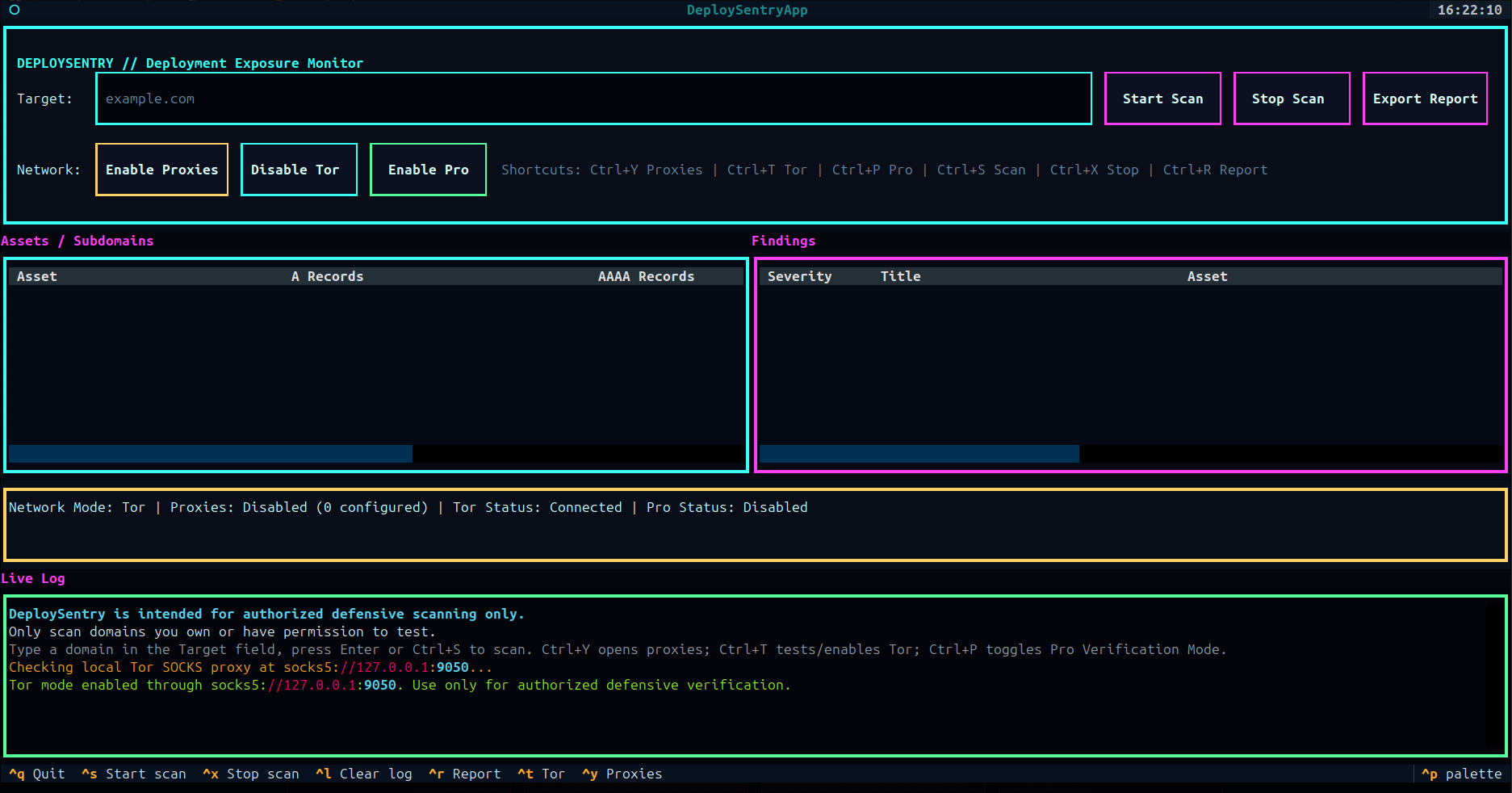
DeploySentry ships with a cyberpunk Textual TUI for live asset discovery, findings, logs, network mode, and report generation.
A safe pipeline for authorized deployment exposure monitoring.
Find subdomains through CT logs, common names, RapidDNS, and CNAME expansion.
Collect A, AAAA, and CNAME records for every discovered asset.
Check HTTP and HTTPS availability using conservative timeouts and concurrency.
Generate clean reports with severity, recommendations, and redacted evidence.
Use the direct CLI for automation, or launch the TUI for live monitoring.
# interactive mode
deploysentry

# direct scan
deploysentry scan example.com

# reports
deploysentry scan example.com --report html
deploysentry scan example.com --report json
deploysentry scan example.com --report markdown

# network verification
deploysentry scan example.com --tor
deploysentry scan example.com --proxies proxies.txt --proxy-mode rotate
SURFACEZERO_API_KEY=your-key deploysentry scan example.com --pro
Start with your own root domain, review safe evidence, and close the leaks before they show up in someone else’s scanner.
DeploySentry is intended for authorized defensive scanning only. Only scan domains you own or have explicit permission to test. It does not exploit vulnerabilities, dump secrets, clone repositories, brute-force credentials, bypass authentication, or perform aggressive scanning.